Description
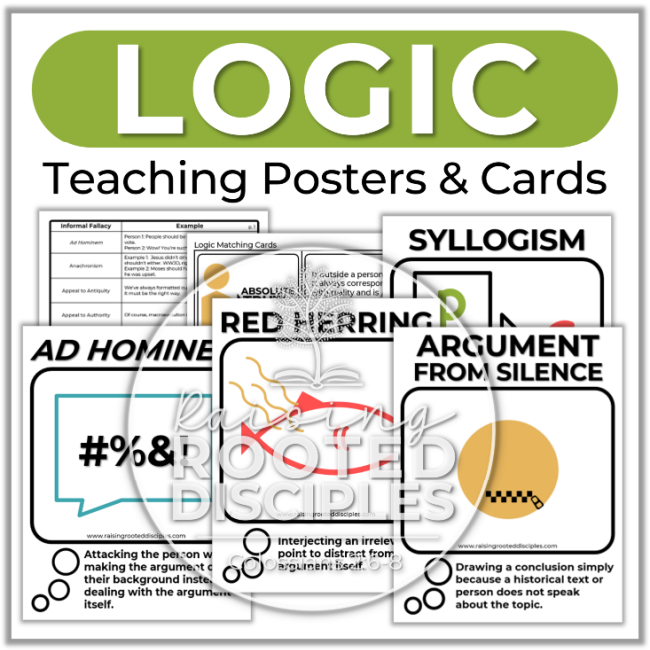
These Logic Teaching Posters and Cards compliment any logic book or curriculum!
We are told in Scripture to love the Lord our God with all our heart, soul, and mind. {Matthew 22:37} We are also told to renew our mind in His Word. {Romans 12:1-2} In other words, our mind is important to the Lord!
Before we send our kids out into the world, we want to teach them how to think critically about what they believe and why they believe it. We want them to be able to give reasons for the hope they have. {1 Peter 3:15}
Logic Teaching Posters and Cards
We want them to be able to have logical conversations with others. We want our kids to be prepared to think about their thinking {metacognition} and the thinking of others. One of the ways we prepare our kids to go out into the world is to study logic and informal logical fallacies.
Informal logical fallacies are errors in thinking that can lead one to believe faulty conclusions.
In studying logic and informal logical fallacies with my own middle and high school kids, I couldn’t find posters or resources to compliment our curriculum. {I’m sharing some links to books/curricula below.} So, I created some posters and cards for my kiddos and to share with you here!
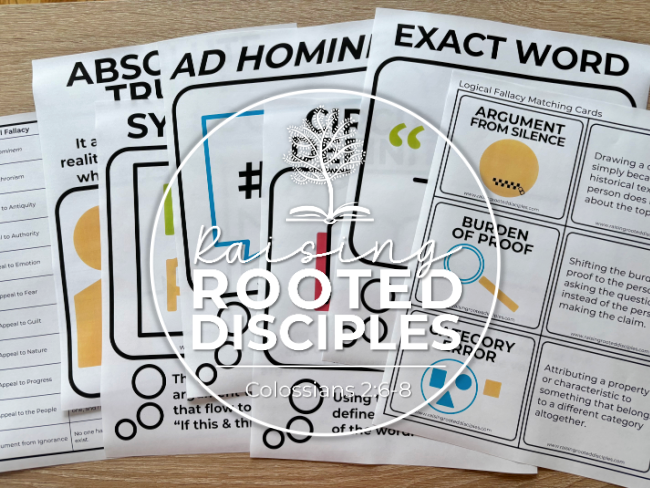
In this HUGE pack, you’ll find posters and matching cards related to:
- Absolute truth {what we should argue from}
- Relative truth {truth varies from person to person}
- The three laws of logic {1- Non-Contradiction, 2- Identity, 3- Excluded Middle}
- Logic definitions for words such as syllogism, premises, and conclusion
- 40+ informal logical fallacy posters & matching cards {match the fallacy to its definition}
- Informal logical fallacy chart with an example for each informal logical fallacy
You’ll find logic posters for informal fallacies you’ve probably heard of such as a Red Herring or Circular Reasoning and ones you may not be as familiar with such as Category Error and No True Scotsman. For a full list of the fallacies included in this resource, see the list at the end of this posting.
Each poster contains an easy-to-understand definition, and the handy chart gives you an example conversation or situation from real life. I’d encourage you to look for more examples on the internet or in the Bible to help your kiddos better understand each fallacy. {For example, the scribes and Pharisees would often use an Ad Hominem when speaking with Jesus.}
A quick disclaimer: I cannot be held responsible for the way your tweens and teens will use knowledge of fallacies against you. Trust me; they will! 🙂
Grab my four FREE Informal Fallacy Posters from this pack over at my blog to sample this pack!
*I am a participant in the Amazon Services LLC Associates Program, an affiliate advertising program designed to provide a means for me to earn fees by linking to Amazon.com and affiliated sites.
Logic Books/Curricula Suggestions by Age:
For Upper Elementary School
- The Thinking Toolbox by Nathaniel Bluedorn & Hans Bluedorn
- The Fallacy Detective by Nathaniel Bluedorn & Hans Bluedorn
- The Amazing Dr. Ransom’s Bestiary of Adorable Fallacies by Douglas Wilson & N.D. Wilson
For Middle School
- The Fallacy Detective by Nathaniel Bluedorn & Hans Bluedorn
- The Amazing Dr. Ransom’s Bestiary of Adorable Fallacies by Douglas Wilson & N.D. Wilson
For High School & Adults
- How to Think Biblically by Joshua Schwisow (curriculum)
- Introduction to Logic by Jason Lisle (curriculum)
- The Christian’s Handbook for Logical Fallacies by Eitan Bar
Original price was: $8.00.$4.00Current price is: $4.00.Add to cart
Grab a copy from my shop ~ Be sure you have a free account before you check out so you can login and download it whenever you want!
You may also like…
The Full List of Informal Fallacies Included in this Resource {in alphabetical order}:
Ad Hominem, Anachronism, Appeal to Antiquity, Appeal to Authority, Appeal to Emotion, Appeal to Fear, Appeal to Guilt, Appeal to Nature, Appeal to Progress, Appeal to the People, Argument from Ignorance, Argument from Silence, Burden of Proof, Category Error, Circular Definition, Circular Reasoning {Begging the Question}, Complex Question, Continuum {The Beard}, Equivocation, Exact Word, False Analogy, False Cause, False Dilemma, Genetic, Gish Gallop, Hasty Generalization, Loaded Question, Middle Ground, No True Scotsman, Part-to-Whole {Composition}, Quoting out of Context, Red Herring, Reification, Repetition, Selection Effect, Slippery Slope {Domino}, Special Pleading, Strawman, Sweeping Generalization {Accident}, Tu Quoque, & Whole-to-Part {Division}

Reviews
There are no reviews yet.